NEILPRYDE was founded by an Olympic sailor, whose original goal was to develop a better understanding of aerodynamics and how to manufacture sails that allowed him to go faster. For 40 years we’ve been working on harnessing the wind, and this understanding of aerodynamics has allowed us to bring a fresh perspective to our wind-cheating bike designs.
The underlying philosophies behind our aero designs are based on:
Real World Aerodynamics: the understanding that when you’re out on the road the wind comes at you from many different wind angles, and very infrequently from 0 degrees (head-on). We design bikes that manage the wind through a wide range of yaw angles.
Variable Airfoils: the airflow around a frame varies according to the location. For example, managing the relatively laminar airflow around the head tube requires a different a tube profile compared to smoothing the turbulent airflow around the down tube coming off the rotating front wheel. Hence the utilization of a variety of airfoil profiles in our bikes.
Balanced Engineering: Aerodynamics are important, but race bikes also need to be light, stiff, responsive and have confidence-inspiring handling.
This approach has lead to designs and engineering solutions unique to NEILPRYDE bikes.
Carbon Fiber
Every bike starts with an idea. It comes from cyclists’ needs and from our desire to create more efficient and innovative bikes. We design, test and refine before concepts become reality.
NEILPRYDE began manufacturing high-performance carbon fiber products in the late 1980s – launching the innovative Matrix system carbon fiber masts and booms to the windsurfing world, at a time when the Tour de France was being won by greats like LeMond, Delgado and Roche on steel frames.
In the last 25 years, NEILPRYDE has been at the forefront of carbon technology and manufacturing processes, allowing us to develop lighter, more responsive, robust and durable record-breaking products for our athletes.
Our designers continue to collaborate with independent experts, like BMW DesignworksUSA, testing laboratories and engineers to foster new technologies and advance the performance of our bikes.
NP Bike Technology
C6.7
C6.7 carbon fiber is used when a high stiffness-to-weight ratio is required while maintaining adequate compliance for the most challenging of races. A blend of medium and high modulus Toray© T700 and 46T, uni-directional carbon fibers are laid-up to maximize strength and keep the overall weight low. Superior strength and durability compared to the industry standard.
C6.9
C6.9 is exclusively composed of the highest-modulus Toray© 46T and 60T, uni-directional carbon fiber possible in bike manufacturing. This blend is 18% stiffer than C6.7 for the same weight, and allows our engineers to ultimately develop significantly lighter frames without sacrificing stiffness.
OTP Stiffness
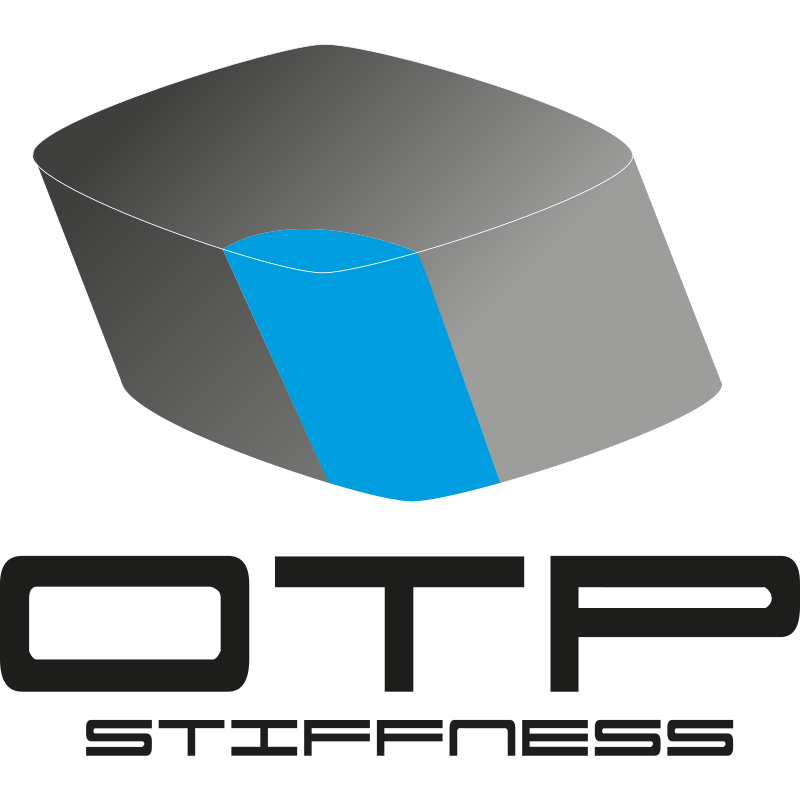
Optimised tube profiles developed using finite element analysis enable frame stiffness to be maximized in critical areas to ensure efficient power transfer.
OTP Comfort
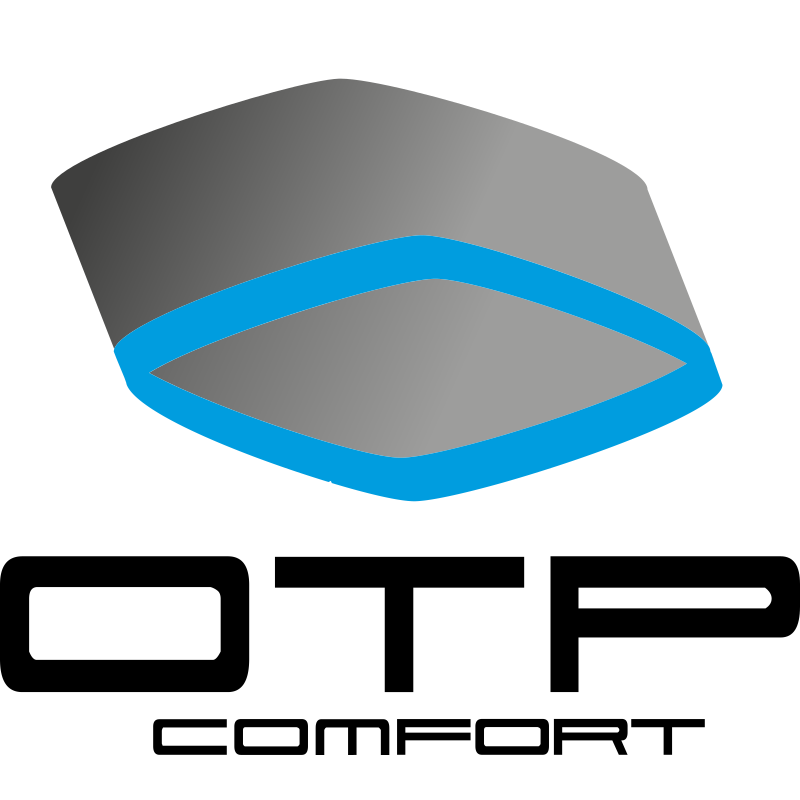
Engineering a more compliant grade of carbon fiber into isolated regions of the frame, combined with adjusting the wall thickness and carbon lay-up in specific tubes, ensures road vibrations are efficiently managed, resulting in a smooth ride.
OTP Lightweight
The tube profiles are designed to achieve the optimum balance between both characteristics. Result: the ultimate racing and climbing bikes.
Exoskeleton
Tubes, joints and transitions incorporate carbon fiber ribs and gussets in strategic locations for optimum power transfer and riding performance. Developed initially for the DIABLO, the Exoskeleton design has been further refined through finite element analysis and applied in specific locations on the BURA SL.
One-Piece Stays
A stiffer, lighter and more responsive bike can be built by reducing the number of joints in the construction of a frame, as extra bonds result in additional carbon required just to bond the numerous pieces together. We developed a unique molding process for the rear triangle that enables the chain stays, rear dropout and part of the seat stays to be molded in one piece, reducing weight and creating a stronger, more durable rear triangle.
PU Molding
NEILPRYDE engineers use a PU mandrel, instead of a traditional, silicone one, for more precise control of wall thickness and to prevent “fiber wash” – the misalignment of fibers during the molding process. Used in forming of the intricate head tube and seat tube joints, and bottom bracket shell which are critical for ensuring precise handling and power transfer.
OTP Aerodynamics
Variable tube profiles are optimised to reduce drag through a wide range of wind yaw angles and relative to the nature of the airflow at specific locations on the frame. Wider airfoil profiles are utilised to achieve the balance between aerodynamics and stiffness.
Di2 Integration
A number of models feature full Shimano Di2 electronic gear-shifting system integration. Internal cables and battery can be completely hidden inside a cavity, resulting in a cleaner, more aerodynamic design.
AeroBlade Cockpit
The wind impacts the handle bar before any other part of a frame, with a standard cockpit accounting for up to 15% of the total drag on a bike. The NeilPryde Aeroblade cockpit has been designed with an integrated stem, an aerofoil bar, and a narrower width to help the rider adopt a narrower frontal profile, which decrease the overall aerodynamic drag on rider and bike.